
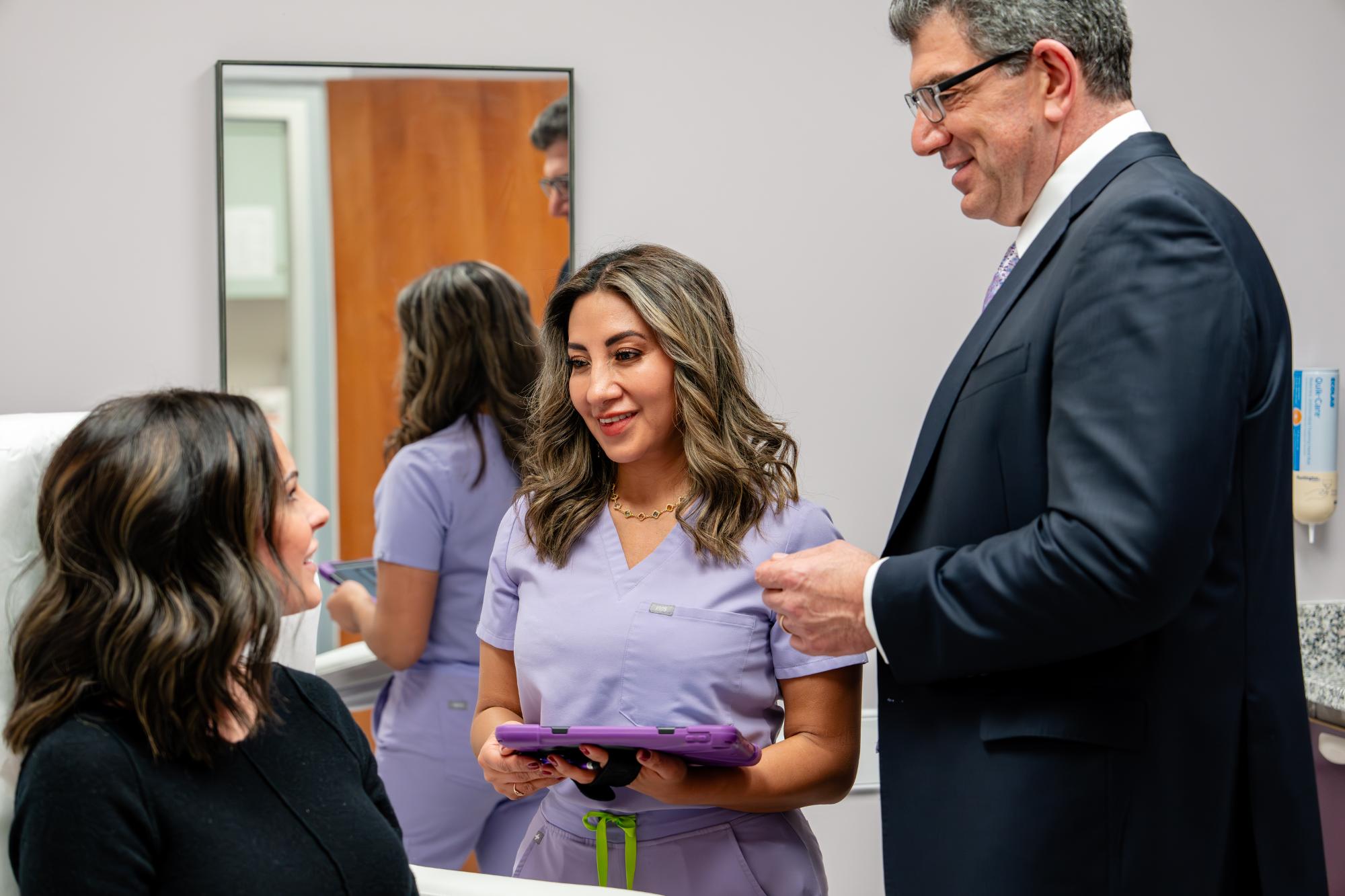
Not long ago, I met with a woman and her husband for a mommy makeover consultation. She had been through two pregnancies, including a C-section, and wanted to talk about some of the changes she had noticed in her breasts and abdomen since having children.
Her husband came with questions.
Good questions, actually.
By the end of the consultation, I realized many of his questions were probably the same ones other spouses and partners have when someone they love starts considering a mommy makeover.
After more than 25 years as a plastic surgeon, I’ve learned these conversations are important. A mommy makeover may be one person’s surgery, but the decision and recovery often involve the whole family. I welcome spouses and partners to consultations when my patients want them there, because I’d much rather have everyone ask their questions openly than leave with unaddressed concerns.
So, I wrote down six of the questions this husband asked me. Here’s how I answered them.
1. “Why Can’t She Just Go to the Gym More?”
This is probably one of the most common questions I hear from spouses and partners. It gets at an important misconception about what a mommy makeover is meant to address.
Exercise can do a lot. It can strengthen your abdominal muscles, build your chest muscles, help you maintain a healthy weight, and improve your overall health.
But exercise cannot remove excess skin or reverse all of the structural changes caused by pregnancy.
During pregnancy, the abdominal skin stretches considerably. The abdominal wall can also stretch and separate, contributing to looseness or bulging that may remain even when a woman is lean and physically fit. You can do sit-ups every day and have very strong abdominal muscles, but exercise alone cannot necessarily correct those changes.
Something similar can happen to the breasts. During pregnancy and breastfeeding, the breasts increase in volume and then decrease again. Even women who don’t breastfeed can experience significant changes. That cycle can leave the breast skin stretched and the breasts looking deflated or lower than they did before pregnancy.
No amount of bench presses can tighten stretched breast skin.
That’s an important distinction: a mommy makeover isn’t a substitute for going to the gym. It addresses certain physical changes that diet and exercise simply aren’t designed to correct.
Many of the women I see have already spent years trying to address these concerns on their own. They exercise. They eat well. They lose their pregnancy weight. Yet there are still areas of their body that don’t look or feel the way they did before having children.
Those are the concerns we’re talking about when we discuss a mommy makeover.
2. “Isn’t This a Lot of Surgery at One Time?”
Yes, it can be a significant operation. I don’t minimize that.
A mommy makeover isn’t one standardized procedure. It’s a term we use for a customized combination of procedures designed to address the areas that changed with pregnancy and childbirth. Depending on the patient, that might include a tummy tuck, breast augmentation, breast lift, liposuction, or some combination of procedures.
Naturally, that raises the question: Is it safe to do several things at once?
My first priority is always safety.
Before deciding what procedures we can perform together, I evaluate the individual patient, her health, the procedures she is considering, and what we can reasonably accomplish in a single operation.
For many healthy women undergoing common mommy makeover procedures, we can safely combine procedures into one surgery. But that decision is made individually. If I don’t think a particular combination of procedures is appropriate to perform at the same time, then that isn’t the plan we’ll choose.
The goal isn’t to see how much surgery we can fit into one day. The goal is to develop a treatment plan that makes sense for that particular patient while prioritizing her safety.
That is one reason the consultation is so important. A mommy makeover should never be treated as a predetermined package. We need to determine what you want to address and then decide the safest, most appropriate way to do it.
3. “What If Something Goes Wrong?”
I understand why spouses ask this question.
When someone you love is choosing to have elective surgery, it’s natural to think about risk. And because a mommy makeover is cosmetic surgery, there can be an added feeling of, “Why take any risk if she doesn’t have to have the operation?”
The first thing I tell patients and their families is that every operation has potential risks. Cosmetic surgery is no exception.
Our job is to identify and reduce the risks we can control before surgery. That starts with making sure someone is an appropriate surgical candidate and carefully reviewing her health and medical history. If medications or medical conditions could affect surgery, we address them beforehand.
We also discuss potential complications after surgery so patients know what to watch for and what to do if they have a concern.
At Virginia Center for Plastic Surgery, another safeguard I think is important for patients to know about is CosmetAssure.
Our cosmetic surgery patients are automatically enrolled in this cosmetic-surgery-specific insurance program, which covers certain complications during the first 45 days after surgery. That matters because a patient’s regular health insurance generally does not cover complications related to elective cosmetic surgery.
For example, in the unlikely event that a patient developed a complication requiring hospitalization or needed to return to the operating room, CosmetAssure may provide coverage for qualifying expenses.
We hope our patients never need to use it. But I believe it is important to plan for complications rather than simply assume they will never happen.
Surgical complications are uncommon, but “uncommon” doesn’t mean “impossible.” Patients deserve an honest discussion of risks, what we do to minimize them, and what plans are in place should a complication occur.
4. “Will Recovery Be Hard on Our Family?”
This might be one of the most valuable questions a spouse can ask before a mommy makeover.
Because yes, recovery affects the family.
For a period of time after surgery, Mom cannot be the person doing everything she normally does. She needs time to heal, and that means someone else may need to handle childcare, meals, errands, driving, household responsibilities, and the dozens of other things she usually manages.
That can be particularly important for women with younger children. After abdominal surgery, for example, there will be restrictions that can affect a mother’s ability to pick up and carry her children.
So rather than waiting until surgery to figure everything out, we talk about it beforehand.
Can your spouse take time off work? Do you have grandparents or other family members nearby who can help? Will someone need to come stay with you? What responsibilities can be rearranged temporarily? Is there a particular time of year when recovery would be easier for your family?
Sometimes the best surgical plan also depends on choosing the right timing.
I don’t want a patient recovering from surgery while worrying that everything at home is falling apart without her. The more support we can arrange beforehand, the more she can focus on what she is supposed to be doing: recovering.
This is also one reason I appreciate having a spouse or partner at the consultation. They hear the recovery expectations directly from me, and we can talk realistically about what those first days and weeks will look like.
A mommy makeover is elective. You usually have time to plan around work, school, childcare, and family commitments. Take advantage of that.
5. “What If She’s Never Satisfied?”
I understand where this concern comes from, particularly as cosmetic surgery has become more visible and commonplace.
A spouse may wonder whether a mommy makeover will be the beginning of one procedure after another: Will she fix one thing and immediately find something else she doesn’t like?
That generally isn’t what I see in my practice.
Most women who come to me for a mommy makeover have very specific concerns. And often, those concerns have been bothering them for years.
They may have lost the pregnancy weight but still have loose abdominal skin. They may exercise regularly but continue to see an abdominal bulge. They may feel uncomfortable with the changes in their breasts after pregnancy and breastfeeding. They put on certain clothes and simply don’t feel like themselves anymore.
These usually aren’t concerns that appeared yesterday.
That is why setting expectations is such an important part of the consultation. Cosmetic surgery is about improvement, not perfection. We talk about what surgery can reasonably accomplish, what it cannot accomplish, and what the patient hopes will be different afterward.
When we have a patient with a specific concern, realistic expectations, and a surgical plan designed to address that concern, the goal isn’t to create an entirely different person.
It’s to help her feel more comfortable with the body she already has.
6. “Does She Really Need This?”
No.
And I think that is an important answer for a plastic surgeon to be willing to give.
No one needs a mommy makeover in the way someone needs an operation to treat an illness or repair a serious injury. A mommy makeover is elective cosmetic surgery.
So I would reframe the question.
Instead of asking, “Does she need this?” ask: Why does she want to do it?
Is there something that has bothered her for years? Does she understand what surgery can and cannot change? Are her expectations realistic? Is she doing this because she wants to do it? Would addressing these concerns help her feel more comfortable and confident in her own skin?
Those are much more useful questions.
For many women, motherhood means years of focusing on other people. They take care of their children. They take care of their families. They work. They manage schedules. Their own wants can gradually move farther and farther down the list.
For some women, considering a mommy makeover comes at a point when they’re finally ready to address something that has bothered them for a long time.
That doesn’t mean every mother should have cosmetic surgery. It doesn’t mean surgery is necessary to feel confident. And it certainly doesn’t mean there is anything wrong with a woman’s body because it changed after pregnancy.
It simply means that if those changes bother her, she has the option to explore what can be done about them.
The question isn’t whether she needs surgery.
It’s whether she wants it, understands it, is an appropriate candidate for it, and is choosing it for the right reasons.
Your Spouse Doesn’t Have to Be Sold on a Mommy Makeover—But They Should Be Part of the Conversation
One thing I appreciated about the husband who asked me these questions was that he asked them.
He didn’t have to pretend he wasn’t worried. He didn’t have to immediately understand why his wife wanted surgery. He came to the consultation, listened, and raised the concerns that were on his mind.
That’s exactly what I want.
If your spouse or partner is considering a mommy makeover, ask questions. Talk about safety. Talk about recovery. Talk about why she wants the surgery. Talk about what she expects afterward.
And if she would like you to attend her consultation, come with her.
My role as a plastic surgeon isn’t to convince someone to have cosmetic surgery. It’s to help patients understand their options, determine whether surgery is appropriate for them, and make an informed decision with realistic expectations.
After more than 25 years in plastic surgery, I’ve seen many women reach this point after spending years caring for everyone else. For the right patient, a mommy makeover can be an opportunity to address physical changes from pregnancy that have continued to bother her despite diet, exercise, and time.
She isn’t trying to erase motherhood or become somebody new.
Sometimes, she just wants to feel a little more like herself again.
If you or your spouse have questions about mommy makeover surgery, we welcome you to schedule a consultation at Virginia Center for Plastic Surgery. Bring your questions—even the skeptical ones. A thoughtful decision starts with an honest conversation.